
Today in Throwback Thursday (Seb: late, yep) it is the British XXX Corps that took part in Operation Market Garden in September 1944. In this complex and highly ambitious operation the XXX Corps was to take a large role in supporting the British and American paratroopers taking the bridges crossing the rivers; mainly with tanks. However, due to a long series of events, XXX Corps could not reach its goal and the operation failed. Was XXX Corps solely responsible for this failure or was it due to other factors? Let’s find out.
Category: Historical Articles
The Fiat 2000(picture heavy)

Original post(seriously, this site needs more exposure)
Author: P Kempf. Editor: Charlie Clelland. With many photos provided by “PDA” and Hans van Oerle
Considering the fact that during WW1 Italy’s main fighting was done in the alpine areas on the border to Austria-Hungary, it is not remarkable that their efforts when it came to tracked armoured vehicles was not en par with those of Britain and France. Considering the weak industrial base of Italy, it can be called quite impressive, when you remember the circumstances. Continue reading “The Fiat 2000(picture heavy)”
Marvin Heemeyer’s Armored Bulldozer
This is what I meant when I said that I was writing an article about an “unorthodox weapon”. It’s an impressive vehicle. Hope you guys enjoy the article.
http://mountaintownnews.net/wp-content/uploads/2014/06/a-the-dozer.jpg
The “Tracked” Steam Tank
Author: P Radley
This large tank weighed 50 American tons (45 tonnes), had ½-inch thick (maximum) armour, a crew of 8, and had two 2-cylinder steam engines developing a total of 500hp, which moved it at 4mph (maximum). It was 34ft 9in (10.6m) long, 12ft 6in (3.8m) wide, and 10ft 4½in (3.2m) high. It was based on the British rhomboids, but had a distinctive shape all its own. Perhaps the most notable feature of it was the mud-clearing spikes on the front horns.


The Wilton-Fijenoord Overvalwagen – Forgotten by time
Hello readers, Shadyrush back with a brand new article. It’s been a while since I last wrote one, time didn’t allow me to make new ones but with the holiday starting, now’s a good a time as any to publish a new one. This article won’t be as lengthy as the last one, so it’ll be a light read.
As you probably guessed, this article will be about the Wilton-Fijenoord Overvalswagen. This design had the honor to be the first type of armoured car to serve with the Dutch army.(although very briefly) So why is it so unknown? Well, only 3 were made and there isn’t much information on these vehicles. Another thing to note is that they were designed and produced by a shipyard. The shipyard shared its name with the armoured car: Wilton-Fijenoord. This company was established in 1929 out of a merger of two Rotterdam shipyards, Wilton and Fijenoord. After the merger many activities were concentrated in neighbouring Schiedam, home of Dutch jenever distilling. In the early 1930s W-F acquired a licence to produce Bofors guns. Because this shipyard was one of the few arms manufacturers in the early 30’s the Dutch minister of colonies ordered two 6 wheel armoured cars to be built on the Krupp 22H143 chassis.
This vehicle would be known as the Wilton-Fijenoord Overvalswagen


Continue reading “The Wilton-Fijenoord Overvalwagen – Forgotten by time”
The Garford-Putilov Armoured Car
Today is quiet too, so I made another historical article. It’s quite makeshift this time.
Schemes: Yuri Pasholok’s blog
https://scontent-arn2-1.xx.fbcdn.net/t31.0-8/13308246_1741045479473145_4226591124171782974_o.jpg
Garford-Putilov Armoured Cars were produced in Russia during the First World War (starting with 1915). They were built on the frames of Garford Motor Truck Co. lorries imported from the United States.
Although considered to be a rugged and reliable machine by its users, the Garford-Putilov was severely underpowered. With a total weight of about 11 tons, and only a 30 hp engine, the vehicles had a top speed of approximately 10–11 mph (16–18 km/h). The design was also overloaded (top-heavy), and therefore had very limited off-road capabilites.
Besides the countries that emerged from the ruins of the old Russian Empire, Garford-Putilov armoured cars were also deployed by German forces. The Germans captured several of the vehicles, and put them to some use towards the end of World War I, and post-Armistice in the “Freikorps”. The armored cars also saw action in the Russian Civil War.
Armament: 76 mm (3 inch) mountain gun variant and two machineguns.
Number produced: 48 (total)
Ammo: 60 shells
Armor: 6,5 mm.
https://scontent-arn2-1.xx.fbcdn.net/t31.0-8/13320523_1741045476139812_3035848266387736088_o.jpg
https://scontent-arn2-1.xx.fbcdn.net/t31.0-8/13340148_1741045482806478_8576021708638521144_o.jpg
How it looked like in Latvian service:
http://i.imgur.com/gEcO5XZ.jpg
Bizarre armor projects of the ’40s. Wired tanks
I stashed this translated article for worse days, but since today was mostly silent, it is time to finally post it. Translation: Vlad (Wowanator)
http://static-ptl-ru.gcdn.co/dcont/fb/image/2electro.jpg
“The electricians… will destroy the ugly face of Fascism. Electric tanks will help this cause”. Electrical engineer A.I. Bogun-Dobrovolsky wasn’t shy about his expressions, writing about his invention in July 1941.
Fuel was as important for a tank as were armor and armament. If fuel was to run out or freeze – the tank became an immobile firing point. An explosion of the fuel tanks almost certainly meant the end of a tank. Many inventors asked themselves: why don’t we electrify the tank? And thus, projects like the ones mentioned below appeared.
Bogun-Dobrovolsky’s electric tank
“An electric tank is a combat vehicle steered through a cable. The armament of the electric tank (ET) can consist of torpedoes, mines, HE shells up to 200kg or the ET could transport an explosive device… and ignite it”.
The inventor’s decription suggested that the vehicle should consist of three parts. The first was the power supply. Bogun-Dobrovolsky described it as a modular device, able to connect to any source of three-phase alternating electric current. The inventor assumed that this would be easy to find in a combat zone: “Suburbs, industrial areas, thermal or hydraulic power stations etc.”. In the power supply, a rotating drum is placed, which is split in three parts. Each sector was corresponded to a separate two-wire cable responsible for powering the engines and the ignition of the armament.
Continue reading “Bizarre armor projects of the ’40s. Wired tanks”
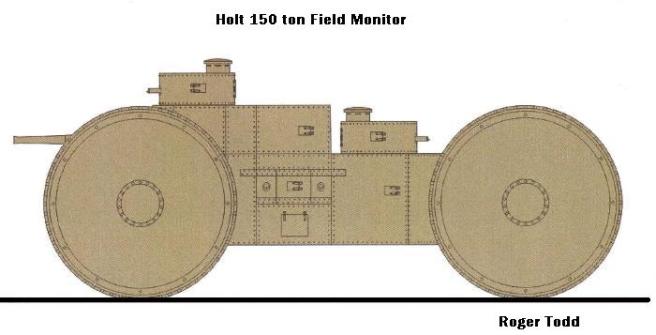
WW1 Landship Designs: 150 ton Field Monitor and the 200 ton Trench Destroyer
Author: Tim Rigsby, Editor: Charlie Clelland, Illustrator: Roger Todd
The 150 ton Field Monitor
The 150 ton Field Monitor was a product of America’s growing industrial might, as well as the republic’s anticipation in becoming involved in the First World War.
Tier 10 American Tank Candidate: General Electric's A-10 on Tracks
Author: SovietTenkDestroyer
I have a short but entertaining article for you. If you know what the A-10 is, you’ll know what I’m talking about. Yes, I’m serious… Well sorta’. Think of it as a Pz. I C being force fed with steroids because it is being trained to fight in a deathmatch in some future dystopia. Anyways, this is a M48 Patton with a GAU-8… Yes, you heard it, GAU-8! I know this sounds incredibly ludicrous, however, we don’t have enough novelty tanks in-game /sarcasm. To be honest, I am not really serious; this tank would most likely be weak because of how hard it would be to balance. It would be fun to see this in-game with 4000 rounds a minute doing about 1 hp of damage or so if it can even penetrate.
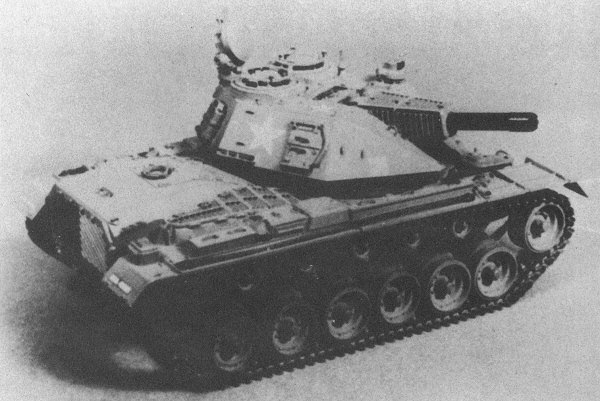
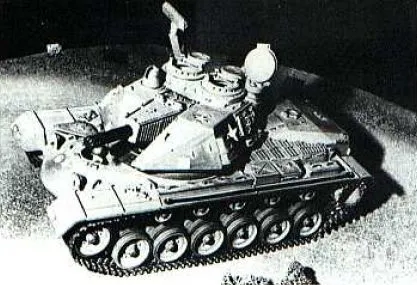
General Electric’s proposal to the DIVAD program
There is not much information on this vehicle other than the tank was born out of the need of a new SPAAG during the 60’s and 70’s when the M42 Duster was removed only to be reintroduced for the Vietnam War. Various companies such as Ford, General Dynamics, Raytheon, General Electric, etc, participated on the DIVAD program with requirements to make an anti-aircraft vehicle based on the M48 Patton. General Electric presented their version of the DIVAD vehicle armed with a 30mm GAU-8 gatling gun and a cool looking turret to go with it. Ford’s proposal won and became later known as the M247 Sergeant York which was armed with two 40mm Bofors L/70 anti-aircraft guns (longer and upgraded 40mm Bofors guns we’ve been seeing on the Cruiser tanks). The tank was plagued with reliability issues and such and was considered a failure with less than ten years of service.
Continue reading “Tier 10 American Tank Candidate: General Electric's A-10 on Tracks”