Boirault Machine (Anti-barbed wire Vehicle)

Original article. 

Author: Tim Rigsby

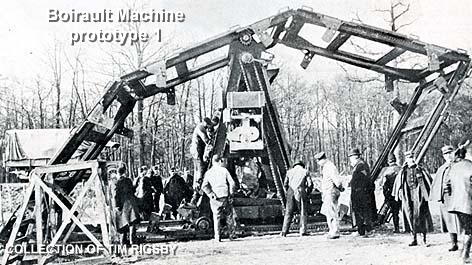
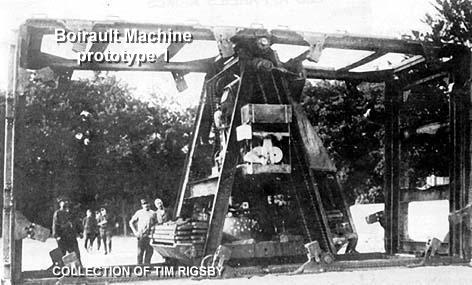
These vehicles were designed by a French engineer known as Mr.Boirault. Mr.Boirault proposed the Boirault Machine (prototype 1) in December 1914, to help combat the ever growing nuisance of barbed wire and static warfare. His attempts developed into two of the strangest vehicle designs of World War One.

boirault_1

Boirault Prototype 1

This vehicle was designed to be capable of crossing muddy trenches, and crushing the dreaded miles of barbed wire. It consisted of six metal frames sliding on a pyramidal structure. The driving compartment was situated in the middle, and was supported by large girders. This was also where the petrol engine was located, it helped propel the monster to a maximum of 3 kph. Propulsion was achieved by the motor turning chains and driving rods, which were connected to the metal girders.
boirault_2

Continue reading “Boirault Machine (Anti-barbed wire Vehicle)”

Sweden’s Domestic MBT Project: Strv 2000 T140/40

Hello! I’ll be posting an article that did not come from me. Tanks-Encyclopedia sent us this article for us to post.

Author: Eric Matzner

Illustrator: David Bocquelet

3D Illustrator: Arkhonus

Strv-2000-1.png

3D Model of the Strv 2000 T140/40

Sweden’s MBT that never was

The Strv 2000 project was intended to fulfill Sweden’s need for a modern main battle tank (MBT). In 1984 the Swedish government began to look into replacing the Strv 103 and Strv 104 tanks it had in service.

The intent was to assess the feasibility of a Swedish design, as well as to look foreign designs. These were to be either to be built under licence in Sweden, or ordered from a foreign manufacturer. The vehicle that would be chosen would come into service around the year 2000, hence the name of the Swedish prototype.

The Millennial MBT

In the late 1970’s, the Swedish Military began to shift from a more defensive focus in their armored fighting vehicles to more of an emphasis on main battle tanks.  The driving force behind this call for a new tank was Colonel Bjorn Zickerman, who was also instrumental in helping develop the Ikv 91 in the 1970’s.

In order to find a new vehicle, the idea was to compare several modern MBTs such as the M1A1 Abrams or Leopard 2, to a prototype tank developed within Sweden. In 1984, work commenced on the Strv 2000 project.

STRV-103_Centurion.jpg

The tanks in service with the Swedish army at the start of the Strv 2000 project, the Strv 103 and the Strv 104 (modified Centurions)

Sweden had several requirements as to what the Strv 2000 would need to be, regardless if it was a foreign vehicle or developed domestically. This new vehicle was to have an emphasis on crew safety, as well as survivability of the vehicle. These were to take precedence over all other elements such as armament and mobility. In order to keep training simple, the vehicle also had to be simple to operate.

In addition to these stipulation, there were three main objectives that the Strv 2000 had to meet. Firstly, it would need to be able to fire in any direction while moving. This could be of concern for lighter tanks, or for tanks with a very large and cumbersome main weapon. Secondly, it was to have good visibility all around the vehicle for the crew inside. Thirdly, there had to be a high survival rate of both crew and the vehicle if the ammunition storage compartment were to be hit or explode.

In order to develop a domestic design, Swedish defense industries first looked back to recent Swedish AFV prototypes under the UDES project in the 1970’s. The prototypes developed in 1984 were designed to meet “Hotstridsvagnar”, or potential and projected AFV threats that may be faced in the future. The two levels used in this project were Hotstridsvagnar VI, equivalent to the T-80, and Hotstridsvagnar VII, equivalent to the second generation T-80.

Making comparisons to these vehicles, and finding how to best combat them guided the development of Swedish prototypes. In 1985, the industry was able to present 3 different ideas for a modern tank built in Sweden. The first would be a traditional MBT layout (turreted tank) with 4 crew members, the second was an MBT with a compact turret and 3 crew members, while the third proposal was another turreted MBT with 3 crew members.

Armament

Continue reading “Sweden’s Domestic MBT Project: Strv 2000 T140/40”

Review of the French tanks – Part 1 : tiers X

Because of various technical problems, as well as some incoming holidays, the next article (so, about the tier IX tanks) will most likely not be posted before July 28th or July 29th. Thanks for understanding, and bonne lecture !


Click here to see the part 0 – Introduction

This post deals with the following tanks :

  • AMX 50 B
  • Batignolles-Châtillon 25t
  • AMX 30 B
  • AMX 50 Foch (155)
  • Batignolles-Châtillon 155 58

Note : giving many times the same hypertext link from one source for a tank will be avoided, even if it’s used several times. So, keep them open while reading !


AMX 50 B

1) Top speed

As we can see here, here and here (photographs from Châtellerault archives by AutoChenille) on a notice from 1959 about the AMX 50 B, the top speed is 51 km/h. However, it’s intended with an engine of 850 hp, and it was planned to equip the tank with an engine of 1.200 hp, which would have theoretically allowed to reach a top speed of 65 km/h (see here, here and here). However, this engine was never developed. So, if you’re a purist, there is a nerf of the vehicle’s top speed, from 65 km/h to 51 km/h. If you however are more tolerant, there are then no changes.

2) Weight

Whether on the plan from 1953, or on the instructions from 1959, or on different sites previously given, we can see that the weight of the AMX 50 B is 57,8 tonnes. So the weight should then be decreased from 62,2 tonnes to 57,8 tonnes.

Note : this implies a nerf of the ramming ability, but a buff of the acceleration.

Continue reading “Review of the French tanks – Part 1 : tiers X”

Review of the French tanks – Part 0 : Introduction

Teckyota is a French tanks fan and fights in order to make the French tech tree more complete and more historical. It’s with this intention that he started in November 2013 the topic called L’arbre français“The French tech tree” in French (TN : which may get translated someday), which is still quite an active topic, with over 2600 posts thanks to the support of many players and fans.

Teckyota started once a topic called Critique des chars français, “Review of the French tanks” in French. This topic was meant to show that the current French tech tree could be made much more historical, without destroying the gameplay. Thus, this topic was not a review about the gameplay of the French tanks or about their poor balancing, but instead, a review about their historicity. However, quite complex and poorly structured, this topic soon got forgotten. The new and current topic (TN : the one getting translated) uses the same background as the old one, but with an improved structure.

Now that the introduction has been done, and that the topic’s title’s origin has been explained, here is below how this little serie will be posted. This serie should normally be 9 weeks long, with one tier being studied during 1 week.

Tier X tanks should be reviewed during the 1st week.

Tier IX tanks should be reviewed during the 2nd week.

Tier VIII tanks should be reviewed during the 3rd week.

Tier III tanks should be reviewed during the 8th week.

Tier II tanks, as well as the tier I tank, should be reviewed during the 9th and last week.

Every week, an article will be posted, which will list, thanks to arguments and sources, the changes that seem useful for the tanks of the concerned tier.

Continue reading “Review of the French tanks – Part 0 : Introduction”

What-If: Riachuelo Class Battleship

Article by Redditor thezerech

https://stefsap.files.wordpress.com/2016/01/riachuelo-ld.png

History

After the overthrow of Brazil’s Emperor Pedro II in 1889 Brazil’s Navy had been almost completely ignored due to a series of revolts and conflicts within the country. By the beginning of the twentieth century the situation was very dire, both Chile and Argentina had been in a naval arms race and purchased a number of new modern warships, including the Italian Garibaldi class of armored cruisers. By 1905 the Brazilian government decided to launch a new naval expansion program, that would include the Bahia class light cruisers, as well as number of destroyers, not to mention three pre-dreadnought battleships. However after the battle of Tsushima it was decided to order newer battleships to reflect new naval knowledge. These would eventually become the Minas Geraes class dreadnoughts, ordered from Britain. After the delivery of the Minas Geraes Brazil became the owner of the most powerful battleships in the world this title would be very quickly lost, however it sent shock waves throughout the world, especially in Chile and Argentina, who had just finished a naval arms race of their own. This would become known as the South American Dreadnought race. Argentina received their battleships during the first world war from the United States, after they were built at Fore River, in Quincy, Massachusetts. While Chile chose to have their battleships be built in the U.K however once the first world war commenced the U.K purchased both of Chile’s battleships. The Almirante Latorre would be finally delivered to Chile after the war, while the second Almirante Cochrane would remain in British hands and eventually be converted into an Aircraft carrier, HMS Eagle. Brazil seeing these developments decided to sell the Sao Paolo to the Ottoman Empire, and order a new set of battleships, to be named after the Battle of Riachuelo. However while she was ordered from Vickers she was canceled due to the outbreak of the first world war. She would have been at the time of her completion a very powerful battleship similar to the Queen Elizabeth class and the Bayern class in size, armament and displacement.

Designkindaboring

Continue reading “What-If: Riachuelo Class Battleship”

Romanian Tanks for WoT: Part II – T-26 With Czech Armaments

Translators: Seb and Luke

Romanian T-26.jpg
Soviet T-26 captured by Romania with a Michael’s Cross painted on it

Throughout World War II, the Kingdom of Romania captured various vehicles from their enemies, especially from the Soviet Union on the Eastern Front. These armored vehicles were either used in combat, used for training or scrapped for spare parts and material for the production of domestic armored vehicles.

Continue reading “Romanian Tanks for WoT: Part II – T-26 With Czech Armaments”

The Renault FT(picture heavy)

Author: Peter Kempf, Editor: Charlie Clelland
renault_ft_1
If the French made the worst tank of the war, they also made the very best one, the Renault FT, a quite revolutionary vehicle which set the shape and pattern for tanks of the future, even until today. It came out of a desire to give the standard tanks like the Schneider CA 1 a light partner, designed to be more more useful than the heavy tanks for the exploitation of breakthroughs. It was a joint semi-private project between the maverick father of the French tank weapon, General Estienne, and the french firm of Renault. After many bureaucratic delays the first prototypes were tested in early 1917, and proved to be an immediate success. It included a number of very innovative features, including a manually moved turret.

The turret made the employment of its armament much more flexible and effective, and the whole vehicle was considerably more agile and easy to drive than its heavier partners, yet better protected. Although the short length of the vehicle, rectified somewhat with the addition of the special tail, often made trench-crossing difficult, the track assembly with its large front wheel gave the tank good ability to climb high obstacles. It also proved easily adapted to form numerous variations (besides the basic variants, equipped with either one MG or one 37mm cannon), including a Signals and Command tank (TSF), a 75mm gun tank and a Fascine Carrier.

Both the French and the US used the FT during WW1, and the British and Canadian forces employed some, in the capacity of Liason Vehicle: they removed the weaponry and left the hole open, to enable the passenger a good view forward.

Continue reading “The Renault FT(picture heavy)”

TBTD – Italy – Operation Shingle

As requested by one of our readers today Throwback Thursday will feature an important battle in the Italian campaign; specifically the American/British landing on the beaches of Anzio. This plan was cooked up in order to force a breakthrough; in the by Churchill dubbed; “soft underbelly of Europe”. The article will try to answer the questions; what, why and was this the anticipated succes the Allies had hoped for? Caution: it will be quite a long read. Hope you enjoy!

Continue reading “TBTD – Italy – Operation Shingle”

Steam-powered Tanks

It’s time for yet another historical article! Quite long this time, but I am sure you’ll love it.

Source: Vollketten (shared from WoT NA forums with permission)

From: AFV-G2 Magazine, Vol.5, Number 4 in 1975. By Baron Publishing

Steam Power for Tanks
by Col. Robert J. Icks, Ret’d.

Posted Image

The origin of the tank as such during World War I. Is usually credited to the British, but the French were working on such a device at the same time, with neither knowing of the other’s efforts. But what is not generally known is that the idea for this type of weapon appeared during this period in other countries as well. The Italian Pavesi-Tolatti or Pavesi-Cassali two-turreted tank probably pre-dated both the British and French designs, but it seems not to have progressed beyond the mock-up stage. The Russian Lebedenko was a huge tricycle, which seems to have been built but was not found manageable.
In the United States, Cleve F. Shaffer of San Francisco had tried unsuccessfully in 1914 to interest the German consul there in arming and armouring hundreds of little Fagcol orchard tractors. Norman Leeds of the Automatic Machine Company of Hartford, Connecticut built two mock-up hulls on the chassis of the firm’s commercial ‘Alligator’ vehicle, calling them the ‘Automatic Land Cruiser I. and II.’. U.S. Patent No. 1,161,267, issued to W. T. Taylor in 1915 covers an amphibious tank bearing a remarkable resemblance to the modern LVT(P)5.

The inspiration’ for the British and French tanks was the American Holt tractor, then in use in both armies. It therefore was natural that Holt would capitalise on the fact. The Holt plant at Stockton, California built several mock-up hulls called ‘Special 18’ or ‘Scat the Kaiser’. One of these later was refitted with a Cadillac engine, thereby doubling its speed. There also was a tiny HA 15 one-man tank powered by a motorcycle engine and resembling the British heavy tanks of the period. Another Holt vehicle was the G-9, built at the Peoria, Illinois factory. This was a standard 10-ton tractor with an armoured box surmounted by a small revolving turret at the front and another larger one at the rear. It was tested at the Sandy Hook, New Jersey Proving Ground, predecessor to the Aberdeen Proving Ground facility.

Posted Image

The C. L. Best Tractor Company of San Leandro, California built two mock-up types on their CLB 75 tractor. One had a semi-cylindrical hull with a turret and the other was similar but the hull had flat surfaces. These two machines appeared at a Fourth of July celebration in San Francisco in 1917, in manoeuvres with units of the California National Guard. Another Best vehicle was a tiny cable-controlled demolition tracklayer known as the Wickersham Land Torpedo, which pre-dated the German ‘Goliath’ of World War II. by almost 25 years.

Continue reading “Steam-powered Tanks”