
Author: SovietTenkDestroyer
Hello! I have an article about the BMPT Terminator. This article is going to be posted soon again on Tanks_Encyclopedia (check them out). What tank would you like me to write about in the future? I hope you enjoy it!

BMPT Terminator being showcased at an exposition
Design
The BMPT Terminator (the name “Terminator” is not an official designation, but used by the designers for publicity reasons) is a support combat vehicle which is meant to be used in urban areas. Just by looking at the vehicle itself, it is obviously based on the T-72 without the iconic hemispherical turret, which is exchanged for an unmanned platform with four anti-tank missiles and dual 30mm auto-cannons. The hull has a superstructure attached to it which allows for more space for the crew. Since tanks aren’t really suited for use in urban areas, this is a great alternative because it possesses a rapid enough rate of fire to react to any enemy vehicles in its surroundings and the four missiles are excellent when fighting against heavily armored targets. However, this vehicle is no substitute as it will not perform as your average tank in non-urban areas. While it is still lethal against other targets that aren’t your ordinary tanks, it will not perform and react as well, due to the extreme ranges that tanks battle in. Another advantage that the BMPT has over regular tanks is the elevation and depression. The gun is able to elevate and depress enough to hit at any targets, like building tops and other tall structures.
Continue reading “BMPT Terminator: A Real Life Terminator”
Category: Historical Articles
The Panzerkampfwagen IV – A tank with no name
Good day to you readers, ShadyRush stopping by for a new article. As you can probably guess, this article will be about the Panzerkampfwagen IV or simply Panzer IV to keep the typing simple. Be sure to strap yourselves in before reading, the article is quite lengthy.
The Panzer IV has to be one of the most underrated and least recognized tanks of the war. It had no official Sobriquet like the “big cats” in German service and to be honest, the name wasn’t even that catchy in German; the name roughly translated to “armored fighting vehicle no. 4”. But, even though the tank wore a unoriginal and boorish name it was still the backbone of the Wehrmacht, especially during the early years of the war. In the later stages, it lost a lot of recognition. Why? Because to the American GI, every German tank was a Tiger.
Now, let’s go back to a year long before 1944 and the D-Day invasion. I’ll take you to the year 1934, the first prototype of the Batallionsfuhrerwagen (battalion commander’s vehicle) was constructed by Rheinmetall-Borsig. It was a simple tank, featuring a 5-man crew consisting of a crew commander, gunner, driver, hull machine gun operator and a radioman. The tank featured a low velocity 75 mm gun, the 300-hp Maybach HL 120L gasoline engine and Krupp’s suspension system of leaf-springed bogies. The suspension configuration consisted of four pairs of wheels and four return rollers. Does this tank sound familiar yet? It was the very first version of the Panzer IV.

Continue reading “The Panzerkampfwagen IV – A tank with no name”
Battlefield 1 Historical Trailer Analysis
I know, I am late to the BF1 hype train. However, I did not want to post the trailer without any context or bonus stuff. Since TAP isn’t limited to WW2 (everyone knows when the first tanks were built), I will leave you this very good video. WW1 was after all the war that gave birth to many Eastern European nations (including giving mine proper borders) but I find the 1918-1922 period just as interesting (Russian Civil War, peace treaties, border changes, and Chinese/Mexican civil wars).
Note: The mask of the armored soldier is called the “Sappenpanzer Gesichtsmaske” which was a rare piece of armor issued to snipers and machine gunners. Due to the weight of the mask, it was only issued to soldiers in fixed positions. Even in the trailer you don’t see the armored soldier moving around. He’s stationary, shooting what seems to be a Maxim machine gun.
The US Future Combat System – A new philosophy on MBT’s
Hello readers, my name is Shadyrush, your average Dutch university student who lucks out by having access to a database filled with awesome reports and documents. While I have been lurking around TAP for a while, this will be the first article I’ll be writing for you guys. And hopefully, many more will come.
This article will be about (you guessed it) the Future Combat System or FCS for short. The FCS project is currently suspended, but after looking into it, it can be said that the US MBT philosophy was shifting to the one Germany had in the 1950’s. To explain what I mean by this, I’ll take you into the project itself.
Continue reading “The US Future Combat System – A new philosophy on MBT’s”
Speculation Sunday: Almirante Brown
From Redditor kgskippy10
And I’m back with another Speculation Sunday with a little bit of something different and really off the grid compared to what a lot of people see, or, err, care to see. I choose the Almirante Brown because it is a very unique ship, from a country you would not expect to be having warships during the second World War, Argentina.
http://www.the-blueprints.com/blueprints-depot/ships/cruisers/ara-almirante-brown-c-1-1931-heavy-cruiser.png
General Characteristics
Of Italian design and production, the Almirante Brown was completed in 1929 and commissioned by the Argentinian navy in 1931 after it was delivered. The Almirante Brown was the lead cruiser of the Argentinian navy bearing the C-1 identification. The ships were similarly built to the Italian Trento class, with a few major differences that I’ll talk about later. The Almirante Brown doesn’t have much, or really any, combat history that I can find and was decommissioned in 1961 and scrapped where it all started, back in Italy in 1962.
https://s-media-cache-ak0.pinimg.com/736x/42/79/5d/42795d93d1e8ef05aa33bb0a0efed6bd.jpg
Armament
The Mendeleyev: Another Russian Tank that Never Was
Author: Aleksandr Drobyazko, Editor: P Radley
It is a well known fact, that Russian industry in the beginning of the twentieth century strongly lagged behind the industry of Europe. Nevertheless, the development of the country showed impressive progress. Together with the growth of manufacturing, Russian engineers had been developing a number of interesting projects in different areas of technology, including military ones. One interesting AFV project was offered in 1915 by the Russian engineer Vasiliy Mendeleyev (1886-1922). He was the son of the well known Russian scientist Dmitriy Mendeleev. Vasiliy Mendeleyev had graduated from the Kronshtadt Marine Engineering School, and worked as an engineer at a ship-building factory.
Over the course of several years (1911-1915) and without any assistance, Mendeleev worked in his own time on the AFV project. One of the variants of this machine, with it’s projected weight being about 170 tons, was to be be armed with 120-mm gun placed in the forward part of the armored hull, and with a machine gun in the rotating turret. It carried an ammunition load of 51 shells. The thickness of the armored protection of the hull, was: front: 150 mm, sides and rear: 100 mm. Maximum speed: 24 km/hour. It was to have a crew of 8. The tank was never built.
http://www.landships.info/landships/tank_articles/images/Mendeleyev_4.jpg
Continue reading “The Mendeleyev: Another Russian Tank that Never Was”
Bizarre armor projects of the ’40s. Ramming tanks
Thanks to Vlad for another historical article.
http://static-ptl-ru.gcdn.co/dcont/fb/image/1_ramming.jpg
With the appearance and development of artillery and firearms, the fighting distance where enemies engaged increased constantly. In the 19th century, some distances spanned a few kilometers already. New kinds of explosives were able to crush stone walls, and shells even penetrated steel armor.
In such conditions, ramming became archaic – as a device as well as a tactic. Even if the attack of an enemy by ramming was used, it was only as a last resort. This is confirmed by the example of the Great Patriotic War, where pilots and tanksmen rammed the enemies just because there were no other means to destroy them. Meanwhile, some inventors seriously thought about tanks designed for ramming. Below, three such projects are presented.
Rhinoceros tank
The first project looks like the most logical one. Complaining that a tank which engages in ramming receives damage itself, auto mechanic A.I. Kudryavzev proposed in February 1942 to create a special ramming tank. “Novelties will be: 1) the hull; 2) blinds to protect the air intakes; 3) wheels to transport the tank on railways” – he wrote.
The hull should be equipped with a protruding frontal section suitable for ramming. Kudryavzev noted that it is required to be made from cast steel. The chassis of the tank was protected by armored screens. Additionally, along the hull, angled ribs made of steel should be placed to reinforce the hull.
Continue reading “Bizarre armor projects of the ’40s. Ramming tanks”
Bizarre armor projects of the ’40s. Amphibians on tracks
Good day people, I guess it’s time for a new historical article translated by Vlad.
http://static-ptl-ru.gcdn.co/dcont/fb/image/amfib1.jpg
The ancient Russian prince Oleg marched in 907 A.D. towards Constantinopole, putting his shallops on wheels and setting the sails. This is just one of many pieces of evidence that the idea of combat vehicles which can move by land and by sea is very old.
Swimming tanks appeared only a few years after the introduction of tanks themselves. At the start of WWII, they were actively built and used by all major “tank” powers. But among all these, there were projects which didn’t come to life, since experts deemed them nothing more than fruits of imagination. Like, for example, the following three.
Blyamka’s amphibious cart
On the 4th August 1942, major Rogov of the NKVD received a memorandum accompanied with a drawing of a combat vehicle. The author was a Polish prisoner of war named Jozef Yanovich Blyamka. “His proposed “mechanical cart” is a kind of amphibious tankette with notable aerodynamic characteristics, high speed, maneuverability and terrain passability, armed with two machineguns and a crew of 2-3 men” – the document said.
Blyamka pointed out that his vehicle can be used for offense as well as for defense. Separately, the author emphasized that his “mechanical cart” is also suitable for conditions of chemical warfare. “It is hermetically sealed and air is flowing through special anti-gas windows” – the note said.
Continue reading “Bizarre armor projects of the ’40s. Amphibians on tracks”
The Vezdekhod – a legend of Soviet military history
Original post here.
Author: Aleksandr Drobyazko, Editor: P Radley
In the literature of the 1960s and 70s, it was usually stated that the Vezdekhod was the first prototype of the tank, but the inert imperial administration prevented the inventor from turning the prototype into a real, viable, tank. Even images of the high-grade fighting machine were shown. Actually, the Vezdekhod did not get further than a pre-production model, and the reason for this was simply the problems with the design. Most of the detail in the history of the Vezdekhod can be found in Leonid Fedoseyev’s book “Tanks of the First World War”.
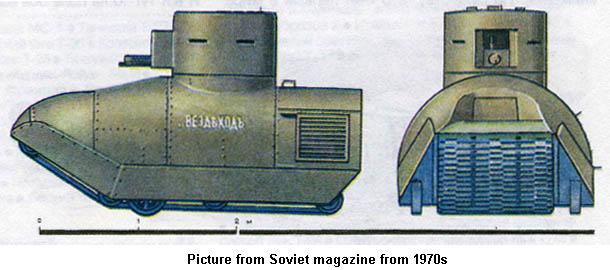
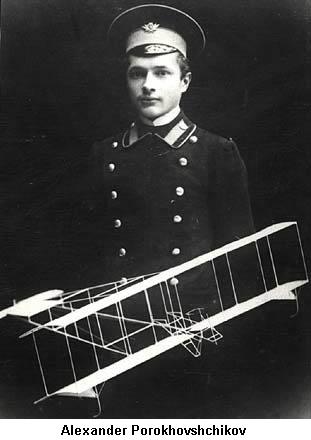
In August 1914, 23-year old aircraft inventor Alexander Porokhovshchikov offered to build a cross-country vehicle. Drawings and the estimate were ready by 9th January 1915. On 13th January, the OK was given for construction to begin. The supervision of the project was done by the military engineer, polkovnik (colonel) Poklevskij-Kozello.
 Continue reading “The Vezdekhod – a legend of Soviet military history”